
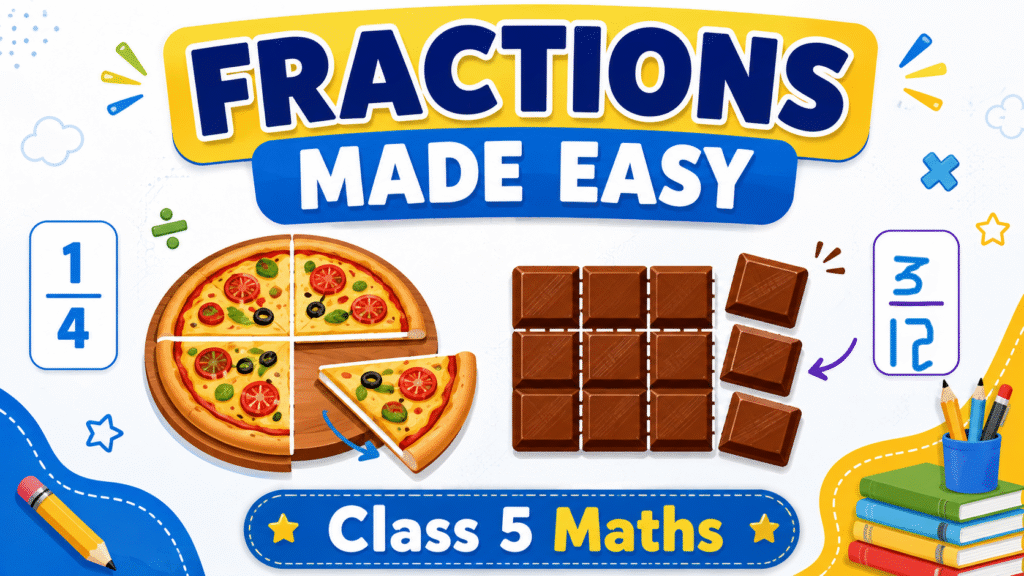
Introduction to Fractions for Class 5
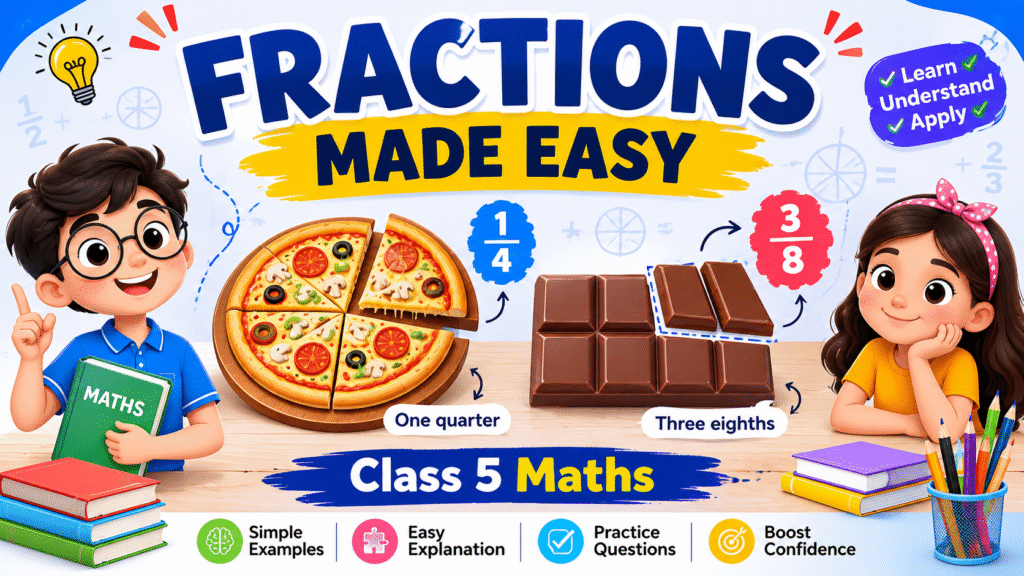
Fractions Made Easy — Class 5 Maths (Complete Lesson + Practice MCQs)
Fractions for Class 5 are one of the most important building blocks of early mathematics. This lesson breaks the topic down into simple, visual steps so that any Class 5 student — whether studying under a local Pakistani board or an international curriculum — can build a solid understanding from the ground up, followed by 12 practice MCQs to test what they’ve learned.
📘 What Is a Fraction?
A fraction represents equal parts of a whole. Whenever an object is divided into equal pieces, each piece is described using a fraction. For example, if a bar is broken into 4 equal pieces and you take 1 piece, you have taken 1/4 (one-quarter) of the whole bar.
Denominator (bottom number): how many equal parts the whole was divided into
Types of Fractions
- Proper Fraction: numerator smaller than denominator (e.g., 3/5)
- Improper Fraction: numerator equal to or larger than denominator (e.g., 7/4)
- Mixed Number: a whole number combined with a fraction (e.g., 1½)
- Equivalent Fractions: different numbers, same value (e.g., 1/2 = 2/4 = 4/8)
Comparing Fractions
When two fractions have the same denominator (e.g., 3/7 and 5/7), the one with the larger numerator is bigger: 5/7 > 3/7. When denominators are different, convert both fractions to a common denominator first, then compare the numerators.
Everyday Examples
Fractions show up everywhere in daily life. Pick the example set that fits your student:
- A roti cut into 2 equal halves — each half is 1/2
- Spending Rs. 25 out of Rs. 100 pocket money — that’s 25/100, or 1/4
- 25 overs completed out of a 50-over cricket match — that’s 1/2 of the match
- A pizza cut into 8 slices — each slice is 1/8 of the whole pizza
- Spending $25 out of $100 — that’s 25/100, or 1/4
- 30 minutes completed of a 60-minute class — that’s 1/2 of the class
📝 Practice MCQs — Fractions (Class 5)
Click “Show Answer” under each question to check your work.
Q1. A chocolate bar is broken into 6 equal pieces. You eat 2 pieces. What fraction did you eat?
- a) 2/4
- b) 2/6
- c) 6/2
- d) 4/6
Q2. Which of the following is a proper fraction?
- a) 9/4
- b) 5/3
- c) 3/8
- d) 7/7
Q3. Which fraction is equivalent to 2/3?
- a) 3/4
- b) 4/6
- c) 2/6
- d) 5/9
Q4. 2/9 + 4/9 = ?
- a) 6/18
- b) 6/9
- c) 8/9
- d) 2/9
Q5. Out of a total of 100 marks, a student scored 60. What fraction of the total marks did the student score?
- a) 3/5
- b) 2/5
- c) 6/10 only
- d) 3/5 and 6/10 both
Q6. Which is the smallest fraction: 3/8, 5/8, 1/8?
- a) 3/8
- b) 5/8
- c) 1/8
- d) They are all equal
More Mcqs
Q7. What type of fraction is 2⅓?
- a) Proper
- b) Improper
- c) Mixed
- d) Equivalent
Q8. 7/9 − 4/9 = ?
- a) 3/9
- b) 11/9
- c) 3/0
- d) 4/9
Q9. A glass is filled with water up to 3/4 of its capacity. What fraction of the glass is still empty?
- a) 1/4
- b) 3/4
- c) 1/2
- d) 2/4
Q10. Which improper fraction is equal to the mixed number 3½?
- a) 5/2
- b) 6/2
- c) 7/2
- d) 8/2
Q11. In a class of 40 students, 16 are girls. What fraction of the class is girls, in simplest form?
- a) 16/40
- b) 2/5
- c) 4/10
- d) 8/20
Q12. Which pair of fractions is NOT equivalent?
- a) 1/3 and 2/6
- b) 2/5 and 4/10
- c) 3/4 and 6/9
- d) 1/2 and 5/10