

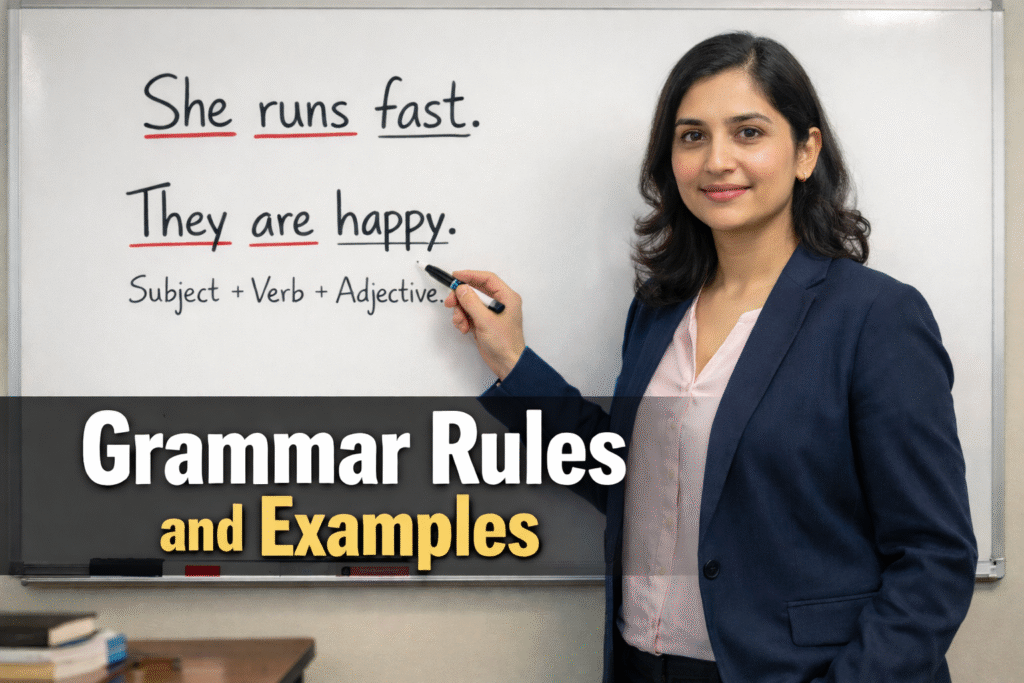
Complete Guide to English Grammar Rules with Clear Examples
English grammar rules is the foundation of effective communication. Whether you are preparing for exams, improving your writing skills, or learning English as a second language, understanding grammar rules helps you express your ideas clearly and confidently. This comprehensive guide explains essential grammar concepts with simple explanations and practical examples.
1. Parts of Speech
In English, every word belongs to a category known as a part of speech. These categories help us understand how words function in a sentence. There are eight main parts of speech, each playing a specific role in communication.
1.1 Nouns
A noun is a word used to name a person, place, thing, or idea. Nouns are one of the most important elements of a sentence because they identify what the sentence is about.
- Person: teacher, doctor, Ali
- Place: school, city, park
- Thing: book, phone, chair
- Idea: honesty, freedom, happiness
1.2 Pronouns
Pronouns are words that replace nouns to avoid repetition and make sentences smoother. They make communication more natural and less repetitive.
Ali is my friend. He is very kind.
Fatima has a book. She is reading it.
1.3 Verbs
Verbs express actions or states of being. Every sentence must have a verb to show what the subject is doing or experiencing.
- Action verbs: run, write, speak
- State verbs: is, seem, become
1.4 Adjectives
Adjectives describe or modify nouns and pronouns. They provide more detail about size, color, shape, or quality.
A beautiful garden
A tall building
An intelligent student
1.5 Adverbs
Adverbs modify verbs, adjectives, or other adverbs. They often describe how, when, where, or to what extent something happens.
She runs quickly.
He speaks very clearly.
They worked efficiently.
1.6 Prepositions
Prepositions show the relationship between a noun or pronoun and another word in the sentence, often indicating place, direction, or time.
This book is on the table.
She walked into the room.
The meeting is at 10 AM.
1.7 Conjunctions
Conjunctions are used to connect words, phrases, or clauses. They help form longer and more meaningful sentences.
I wanted to go, but I was busy.
She is tired because she worked all day.
1.8 Interjections
Interjections express sudden emotions or reactions. They are usually followed by an exclamation mark.
Wow! That’s amazing.
Ouch! That hurt.
2. Sentence Structure
A sentence is a group of words that expresses a complete idea. A basic sentence usually contains a subject and a verb, and sometimes an object.
- Simple sentence: I read books.
- Compound sentence: He reads books, and my friend watches movies.
- Complex sentence: She read books because she enjoy learning.
Understanding sentence structure helps you form clear and grammatically correct sentences in both writing and speaking.
3. Tenses
Tenses indicate the time of an action. Learning tenses allows you to express past, present, and future events accurately.
Present Tense
- He eats breakfast every day.
- I am eating breakfast now.
- You have eaten breakfast already.
Past Tense
- He ate breakfast yesterday.
- I was eating breakfast when he called.
- You had eaten breakfast before he arrived.
Future Tense
- He will eat breakfast tomorrow.
- I will be eating at 8 AM.
- You will have finished before you arrive.
4. Types of Sentences
Sentences can be classified based on their purpose. Understanding these types improves both writing and communication skills.
- Declarative: She is happy.
- Interrogative: Are you ready?
- Imperative: Close the door.
- Exclamatory: What a beautiful day!
5. Common Grammar Rules
Subject-Verb Agreement
Articles
A book, An apple, The sun
Punctuation
Correct punctuation improves clarity and readability.
Example: I bought apples, oranges, and bananas.
6. Active and Passive Voice
In English grammar, sentences can be written in active or passive voice. In the active voice, the subject performs the action, while in the passive voice, the subject receives the action.
Active: Ali wrote a letter.
Passive: A letter was written by Ali.
Using the active voice makes sentences clearer and more direct, while the passive voice is useful when the focus is on the action rather than the subject.
Direct and Indirect Speech
In English grammar, speech can be reported in two ways: direct and indirect. Direct speech uses the exact words spoken by a person, while indirect speech reports the idea without quoting the exact words.
Direct Speech: He said, “I am tired.”
Indirect Speech: He said that he was tired.
Another example shows how multiple sentences are combined:
Direct form: She said, “I am studying. I will pass the exam.”
Reported form: She mentioned that she was studying and would pass the exam.
Understanding this concept is important for writing and narration, especially in formal English and examinations.
8. Common Errors to Avoid
Many learners make common grammar mistakes while writing or speaking English. Being aware of these errors can help you improve quickly.
- Incorrect: He go to school daily.
- Correct: He goes to school daily.
- Incorrect: She don’t like tea.
- Correct: She doesn’t like tea.
Practicing correct sentence formation and reviewing your mistakes regularly can significantly improve your grammar skills.
Conclusion
Mastering English grammar requires consistent practice and attention to detail. By understanding parts of speech, sentence structures, tenses, and grammar rules, you can improve both your writing and speaking skills. Keep practicing regularly, read quality content, and apply these rules in daily communication to become more confident in English.