
The Assistant Director (AD) in the Air Security Force (ASF) is a Grade BPS-17 gazetted officer post under the Federal Public Service Commission (FPSC). ASF is a federal paramilitary force responsible for the security of Pakistan’s civil aviation infrastructure, including airports, aircraft, and VIP lounges. The Assistant Director role involves supervising security operations, managing teams of security personnel, handling intelligence coordination, and ensuring strict compliance with national aviation security standards.
This is a highly competitive post that attracts thousands of graduates every year. Candidates must hold at minimum a 16-year degree (Bachelor’s or equivalent) from an HEC-recognised university. The age limit is typically 21–28 years, with relaxations applicable under FPSC rules for certain categories.
The recruitment process begins with an FPSC-conducted written screening test. The test is fully objective (MCQ-based) and covers multiple subjects. Understanding the paper pattern is the first step to effective preparation.
| Subject | Approx. MCQs | Marks | Difficulty |
|---|---|---|---|
| English (Grammar, Vocabulary, Comprehension) | 20–25 | 20–25 | Moderate |
| Mathematics / Quantitative Reasoning | 20–25 | 20–25 | Moderate–High |
| General Knowledge & Current Affairs | 20–25 | 20–25 | Moderate |
| Pakistan Studies & Islamiyat | 15–20 | 15–20 | Easy–Moderate |
| Security Measure to maintain Law & Order | 10–15 | 10–15 | High |
| Total | ~100 | 100 |
Mathematics carries a significant weightage in the FPSC AD (ASF) test. Questions are designed to test arithmetic reasoning, speed of calculation, and the ability to apply mathematical rules under timed conditions. Candidates who score well in Maths typically gain a strong overall advantage.
This MCQ series focuses on the exact topics that appear most frequently in FPSC AD-level papers:
- Attempt first, then reveal: Read each question and decide your answer mentally before clicking to see the correct option.
- Read every explanation: Even if you answered correctly, the explanation teaches you the shortcut method used in FPSC papers.
- Track weak topics: If you get ratios or percentage questions wrong consistently, note it and revise that topic separately.
- Practise under time pressure: In the real screening test you have roughly 1 minute per question. Try to answer each MCQ within 60 seconds.
- Repeat pages: Come back to the same pages after 2–3 days. Repetition is the fastest way to build speed and accuracy.
Maths MCQs for AD (ASF)
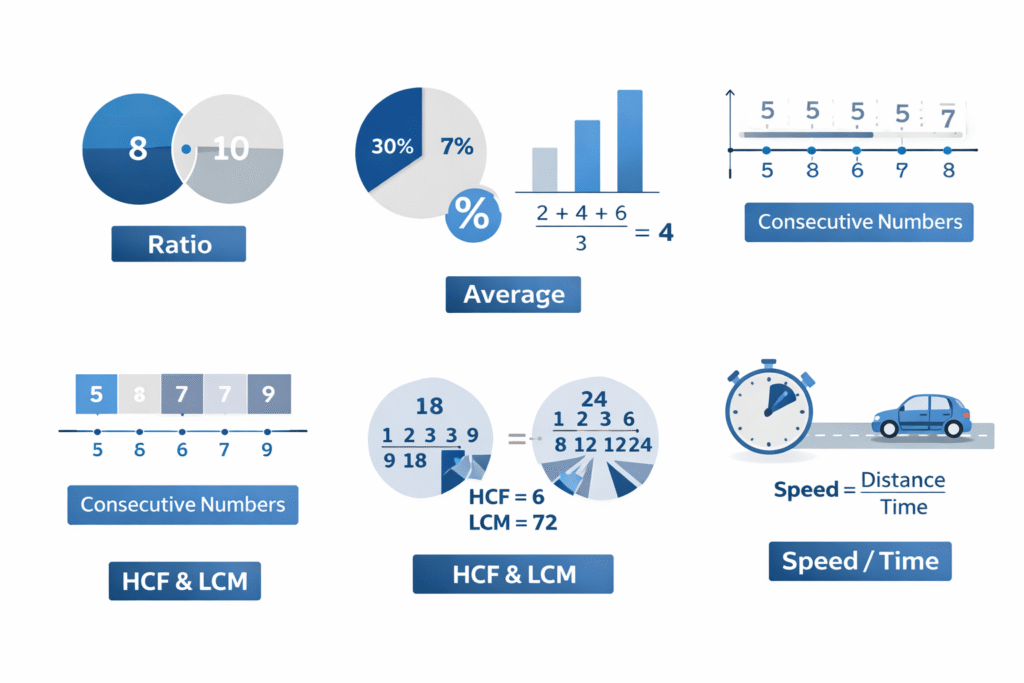
This interactive Maths MCQs for AD (ASF)set has been specially designed according to the FPSC Assistant Director (ASF) screening test pattern and difficulty level. The questions follow the same proportional style as past objective papers, with strong focus on arithmetic reasoning, ratios, percentages, averages, perfect squares, divisibility, consecutive numbers, and operator-based logic. Each question is presented in a clickable MCQ format so that students can attempt it like a real online screening test. After selecting an option, the correct answer and a short exam-oriented explanation are revealed instantly, helping candidates strengthen both speed and conceptual accuracy. This format is particularly useful for AD-level preparation where smart elimination, quick calculation, and objective practice are essential for success.
Q1. √? = (96 × 54) ÷ 18
Q2. The smallest number of 6 digits beginning with 4 and ending with 8 is
Q3. How many numbers up to 150 are divisible by 8?
Q4. The sum of five consecutive numbers is 75. The middle number is
Q5. What number must be added to each term of 4 : 7 so that the ratio becomes 3 : 5?
Q6. The ratio of ages of A and B is 5 : 3. If A is older than B by 8 years, the age of B is
Q47. 25% of a number is 45. The number is
Q8. The average of 9 consecutive numbers is 35. The smallest number is
Q9. What is the least number to be added to 780 to make it a perfect square?
Q10. If a ★ b = 3a + 2b, then 2 ★ 5 + 4 ★ 3 = ?